

Day trip destination
Messner Mountain Museum Firmian
Man and mountain, mountain and man - this recent relationship is the theme of the main seat of the Messner Mountain Museums near Bozen.
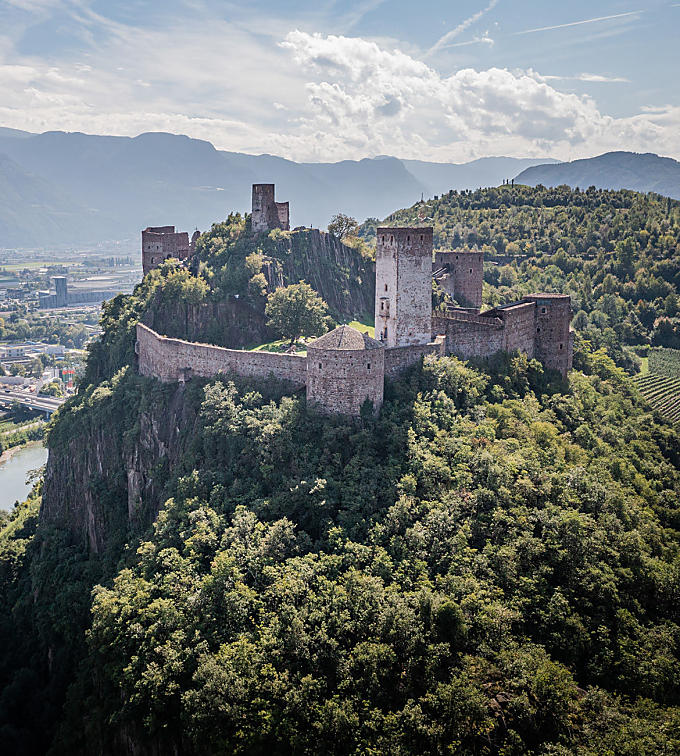
MMM Firmian is located at Sigmundskron Castle, one of the oldest castle sites in South Tyrol. It was first mentioned in records in the 10th century by the name of ‘Formicaria’, which is Latin for ‘anthill’. This description arose because of the shape of the castle. MMM Firmian not only displays mountaineering history, but also a part of the history of South Tyrol's autonomy. In 1957, over 30,000 South Tyroleans came here to protest against violations of the Paris Treaty and for South Tyrol to be granted more independence.
The fascination of the mountains
Mountaineering as we know it has only existed for around 250 years. Before this, mountains were viewed as hostile territory, and were avoided whenever possible. This has since changed, and points of contact with mountains range from conserving nature, conquering mountain peaks and the cult of mountain climbing and mass tourism, to research into the Alpine area. For a long time, the classic sport of mountain climbing was believed to bring religious enhancement, in that God may be said to be found at the summit cross.

(His)story-steeped walls
Firmian castle site perches around 80 metres above the confluence of the Etsch and Eisack rivers. Like an anthill, the castle grounds are marked by large differences in level and feature rocks, lots of green spaces, towers and steps. But where do today’s names of ‘Firmian‘ and ’Sigmundskron‘ come from? After Formigar castle was presented to Udalrich II, the Bishop of Trent, by Emperor Conrad II in 1027, it was looked after in the 12th century by high-ranking civil servants who called themselves ‘von Firmian’, and the name was transferred to the castle site. Three hundred years later, Duke Sigmund the Wealthy, Prince Bishop of Tyrol, bought it, had it extended and gave it the name of Sigmundskron Castle. It is interesting to note that only ruins remain of the original fortress, which are located at the highest point of the castle grounds. Its owners changed a few times over the subsequent years, and it has belonged to the Province of Bozen since 1996. Sigmundskron Castle has seen several conversions so far, including a refurbishment that allowed the ruin to be visited. The architect Werner Tscholl took measures to ensure that its historical features were preserved as best as possible, and hardly any changes are visible from the outside.
All roads lead to Firmian
MMM Firmian is host to regular exhibitions and events, where Reinhold Messner is sometimes even present in person.
Take note: you have to be confident on your feet to visit this museum! The inner courtyard of the castle needs sturdy shoes. MMM Firmian may be accessed by means of a path from Dorf Sigmundskron, which can be reached by several train and bus connections. The castle may also be reached by bicycle.





MMM Firmian
Further information
Contacts
Operation Schedules
To the south of Bolzano, on porphyry rock, a vast castle arrangement, by the way, one oldest is in South Tirol. On account of her impressive situation, it is - as it is due to her beauty - also far away obviously. History: Castle Sigmundskron was called in the first historical mentions about 945 "Formicaria". In 1027 the German emperor gave the dukedom of Trento as well as the county to Bolzano to the bishop of Trento. In this manner the building went over in his possession and was used from now on as a seat of the Amtsmänner responsible for this territory and, moreover, still for high court meetings. An enlargement of the castle in 12. and 13. Therefore, Jhd. became necessary. Very pleasantly for the rulers of the area was the control of the navigation on Eisack and Etsch. The only entrance of Bolzano to Eppan could be closed up to the construction of the first bridge about 1200 easily. About 1473 the castle went over in the possession of Sigmund to the coin empires, princes of Tyrol. The lover of nice castles allowed to develop the arrangement immediately. As his most splendid construction the duke called this "castle Sigmundskron". However, soon afterwards Sigmund gets in financial difficulties. He must pledge his work, the castle slowly goes to ruin, because it is also not inhabited any more constantly. 1957: The next important event which takes place within these walls is the national rally against "Verwelschungsbestrebungen" (lot of Trento), i.e. against the disregard of the "Paris contract" about 1957. In 1976 an innkeeper's family raised for the first time the courage to renovate partially the castle to open the guest company in these romantic surroundings of course also at the same time. In 2006 The sacristan Mountain of museum of Firmian in the castle Sigmundskron/Firmian is opened. Architectural style: The castle is built mainly in the highly medieval style. The slender donjon in the untercastle shows Late-Gothic rebuildings. From the 13th century is the residential tower with round arch door as well as round arch windows. One recognises two gun turrets by the up to 5-m-thick curtain wall in the upper precastle, among the rest, moreover, you find a living - and economic building in the court (the place of the today's restaurant). Specific features: Highly - and untercastle are unambiguously separated by a rock formation, a natural barrier which one often does not find thus. Duke Sigmund made the castle by stonecutters decorate, it had to go nicest in his collection. The different dimensions of the loopholes also do not correspond to the norm of that time.