

Day trip destination
Säben Monastery: South Tyrol’s holy mountain
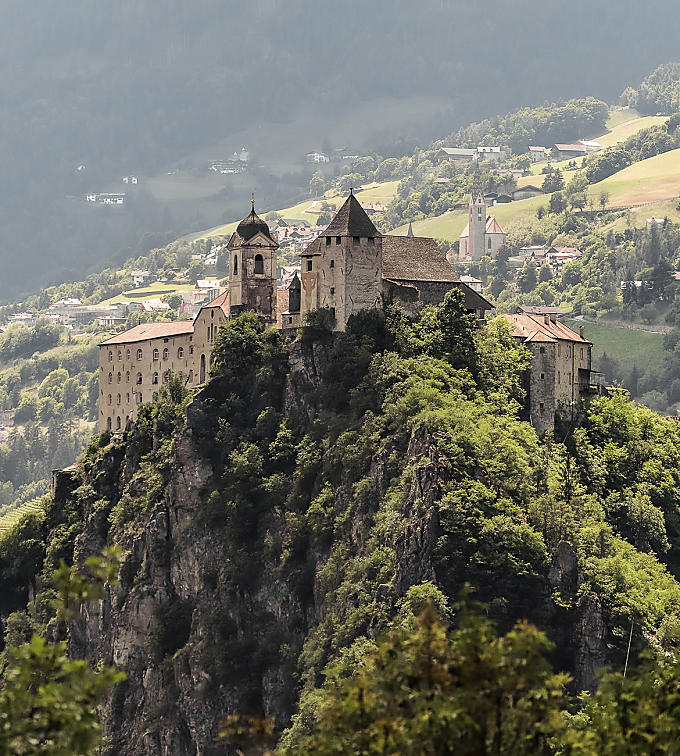
The historic Säben monastery towers imposingly above the medieval town of Klausen in South Tyrol's Eisacktal valley. A place of pilgrimage popular with families too.
Regardless of whether you arrive in Klausen from the north or the south, striking Mount Säben with its Benedictine monastery from the late 17th century, idyllically situated amidst vineyards, dominates the view. A visit to the impressive monastery complex with its Chapel of Grace, Church of Our Lady, Monastery Church and Holy Cross Church is a must for any holiday in South Tyrol. The former bishop’s see is after all one of the most important historical and religious sites in the country. For young and old alike the hike alone is well worth it.
The “Acropolis of Tyrol”
Almost no other place in South Tyrol is as rich in archaeological, historical and art-historical finds as Mount Säben and its monastery. The Christian significance of Mount Säben goes back to the time of the Romans, who founded "Sabonia”, the late Roman settlement and barracks there. The early Christian "Church in the Vineyard" was built between the 4th and 5th centuries. In 600 AD, another chapel was added in the area where the Church of the Holy Cross is located today. A relic from early Christianity found during archaeological excavations, a font for adults, also points to the existence of an early Christian baptistery. During further archaeological excavations in the 1970s, Roman and Germanic graves also came to light. Several finds such as arrowheads, a celt or a flint tool are evidence that the first signs of settlement on Mount Säben date back to the Mesolithic age.

Bishop’s see & place of pilgrimage
In the early Middle Ages, the late Roman settlement “Sabonia” evolved into the diocese “Sabiona”, which was to exist there until around the year 1000, before the headquarters were relocated to Brixen under Emperor Otto the Great. In the period that followed, the complex on Mount Säben near Klausen was converted into a Marian monastery and expanded into the episcopal main castle in the 11th and 13th centuries, which served the bishop as a fortress in times of crisis.
The Säben monastery is one of the oldest pilgrimage sites in Tyrol. The Ladin cloister, already mentioned in 1503, testifies to this. Even today, believers from Gadertal valley make a pilgrimage to the monastery every three years.
A number of architectural changes have been made over the centuries. In 1533 the complex was almost completely destroyed by fire. After that, the monastery remained uninhabited for 150 years before the Church of Our Lady and later also the Holy Cross Church were rebuilt by the residents of Klausen. In 1685 the complex was taken over by nuns of the Benedictine order and consecrated as an abbey in 1699. Between 1880 and 1890, Säben Monastery was renovated for the last time due to the risk of a rock slide.
From Klausen to Säben on foot
Two short walks lead from the lovely historical centre of Klausen to the abbey, which is located around 200 metres above it. A 40-minute walk along the Säben promenade and a moderately steep walk of about 30 minutes along the Way of the Cross. The starting point for both routes is a beautiful old stone staircase near Mühlgasse lane. You can see Branzoll Castle on the way to the monastery, but it is not open to the public. Since the monastery can only be reached on foot, parking is available to the north and south of the city. The few nuns still living in Säben monastery today live in seclusion. Consequently only certain parts of the monastery complex can be visited. These include the Chapel of Grace, the Church of Our Lady, the Monastery Church, the Holy Cross Church and the Jubilee Fountain. Information on the exact opening times can be obtained from the Klausen tourist office.





Säben Monastery
Further information
Operation Schedules
Endtecke den Audioguide: https://www.klausen.it/de/klosterguide.html
Mount Säben (Sabiona) and its monastery deserve special attention for their archaeology, history, and art. There is much to tell about this historic hilltop stronghold above Klausen: around the year 1000, the bishop’s seat was moved from Säben to Brixen. Until then, the Holy Cross Church served for about 400 years as the cathedral of the Diocese of Sabiona.
For more than 335 years, the Benedictine nuns shaped life on the Holy Mountain of Säben, until the order left the monastery in November 2021. Now a new era is beginning: since September 2024, Säben Monastery has been shining again in renewed splendour. Father Kosmas Thielmann, OCist, a Cistercian monk from Heiligenkreuz Abbey in Austria, has taken on the role of chaplain for pilgrims. His aim is to revive Säben as a spiritual centre and an important place of pilgrimage in South Tyrol.
With the support of the Diocese of Bolzano-Brixen and the local community, the monastery is to become not only a place of prayer and meditation, but also a place of encounter and exchange.
Opening hours | Churches and Säben Monastery
- Branzoll Castle: private property, not open to visitors.
- Chapel of Grace (Marian pilgrimage): open daily 08:00–17:00, free admission.
- Church of Our Lady: Open July to October: Tuesdays, Fridays, and Saturdays 14:00–17:00. Further information at the Klausen/Chiusa information office.
- Monastery Church: Holy Mass daily at 11:30 (including Sundays and public holidays). Open daily 08:00–20:00.
- Holy Cross Church: open daily 08:00–20:00, free admission.
- Monastery – chaplain for pilgrims: Father Kosmas Thielmann OCistTel. +39 378 0640185 | Email: [email protected]